Efficient Solutions for Reducing Nitrogen Oxide (NOx) Emissions in the Semiconductor Industry
Efficient Solutions for Reducing Nitrogen Oxide (NOx) Emissions in the Semiconductor Industry

Acid rain and heavy smog — these threats to health and nature are caused by NOx (nitrogen oxides NO2 and NO). Dealing with harmful NOx produced during combustion processes is a real challenge in many industries.
DAS Environmental Experts has developed a turnkey solution for NOx treatment that is suitable for the semiconductor industry and other industries.
What are Nitrogen Oxides and what Effects do they have on the Environment and Health?
Nitrogen oxides, abbreviated to NOx, are gaseous compounds produced by the combustion of fossil fuels such as oil, gas, coal or wood. The group of nitrogen oxides includes nitrogen monoxide (NO) and nitrogen dioxide (NO2).
Nitric oxide (NO) is a colorless, bioactive substance that is used in the body as a messenger substance, among other things. It has a dilating effect on blood vessels and is therefore used in cardiology and heart surgery as well as for the treatment of pulmonary hypertension in newborns. NO can be easily oxidized to NO2 in the atmosphere. Nitrogen dioxide (NO2) is a reddish-brown, highly toxic, pungent-smelling gas that decomposes into nitrogen monoxide and oxygen at temperatures above 200 °C. It forms acid with water and leads to the formation of acid rain; both nitrogen oxides also contribute to the formation of summer smog. The health of humans and animals is endangered by these substances, as nitrogen oxides — especially nitrogen dioxide — irritate and damage the mucous membranes of the respiratory tract and eyes and impair lung function. Inhaling these nitrous gases in high concentrations is extremely dangerous; among other things, it can cause respiratory distress and pulmonary oedema.
Why NOx Reduction Is Becoming Increasingly Important
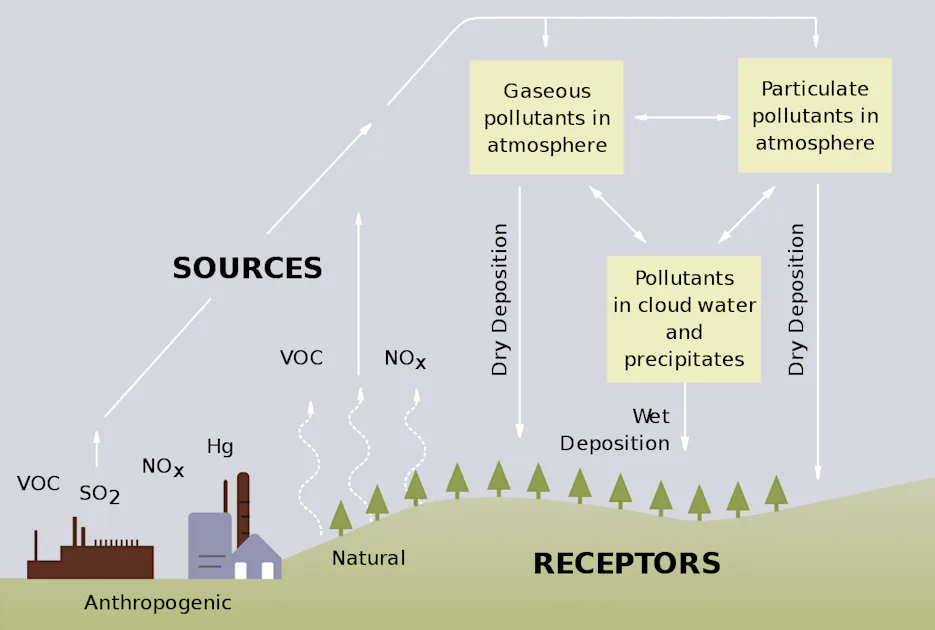
A not insignificant proportion of air pollution is caused by traffic (approx. 37% of total emissions). The stationary sources of pollution, which account for around 30% of emissions, are mainly power stations, waste incineration plants, glass and cement production and oil refineries. Nitrogen oxides can be released not only during combustion processes, but also when working with nitric acid. In addition, the relevance of agriculture as a source of NOx emissions is increasing (approx. 10%).
For this reason, strict limits already apply to nitrogen oxides in many countries around the world. Governments and authorities around the world are endeavoring to further restrict the release of these air pollutants. National environmental regulations such as the TA-Luft in Germany or the EPA in the USA set strict limits for NOx emissions. This is why not only the large NOx emitters mentioned above, but also high-tech industries such as the semiconductor industry, require effective solutions to prevent, reduce or treat nitrogen oxides.
How are nitrogen oxides generated?
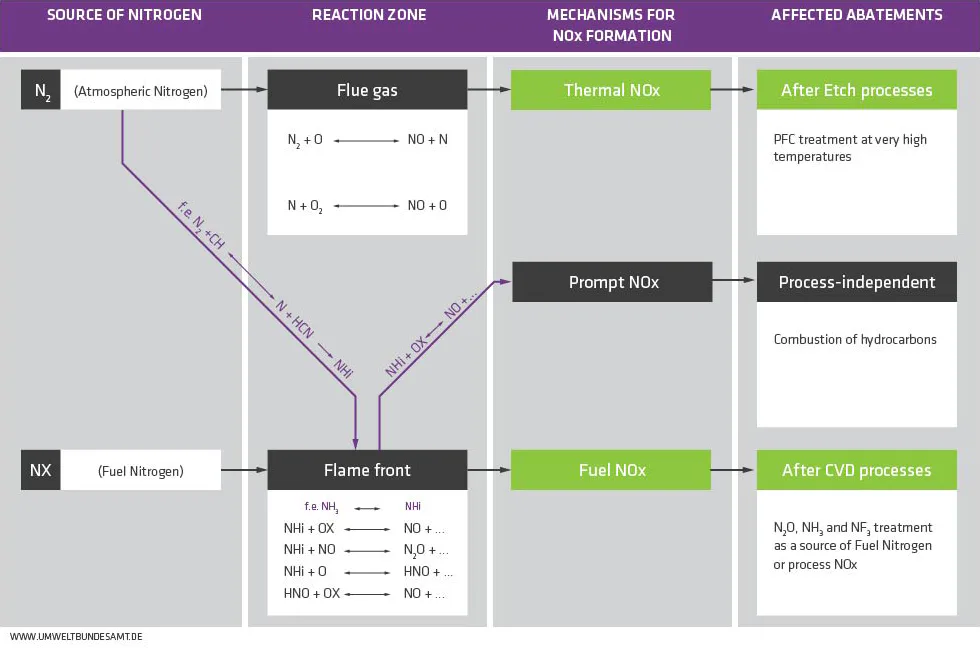
NOx is mainly formed by the oxidation of nitrogen during various combustion processes. A distinction is made between three formation mechanisms. Thermal NOx is formed at relatively high temperatures (over 1300°C) from the nitrogen and oxygen in the combustion air. Fuel NOx is formed from nitrogen chemically bound in the fuel at temperatures of 800°C and above. These complex chemical processes can be strongly influenced by the reaction conditions. It is also possible for nitrogen to be converted to nitrogen oxide, known as prompt NOx, under the influence of fuel radicals (CHx) in the flame front.
In normal combustion processes, 95% of NOx consists of NO. NO2 is mainly formed after combustion with the oxygen in the atmosphere. However, unfavorable process control can also lead to the formation of nitrous oxide (N2O), better known as laughing gas. This substance is used, for example, in medicine as an anesthetic and in the food industry as a propellant. Above all, nitrous oxide is considered a greenhouse gas with an impact 298 times greater than CO2.
Nitrogen oxides in the semiconductor industry
Basically, the semiconductor industry is one of the most resource-intensive industries in the world, with extensive environmental impacts in terms of energy and water consumption and waste production.
Nitrogen is generally used as a protective gas or purge gas in the processing of silicon wafers in clean rooms because the gas is extremely inert under normal conditions — but at high temperatures it can produce thermal nitrogen oxides (NOx). This mainly affects point-of-use incinerators that are used for the removal of perfluorocarbons (PFCs) after etching processes. The temperatures required in the reactor for the decomposition of PFCs promote the formation of NOx as a side effect.
In the semiconductor industry, nitrogen compounds are also required for the deposition of nitride layers, for example. Nitrous oxide is normally used to form oxynitride layers in the chemical vapor deposition (CVD) process. Nitrogen trifluoride (NF3) is used to clean CVD chambers not only in microelectronics production, but also in the production of thin-film screens and thin-film solar cells, and ammonia (NH3) is also used in the production of crystalline silicon solar cells.
The unreacted residues of these nitrogen-containing compounds are usually disposed of thermally together with other process gases and are therefore considered to be the source of the nitrogen oxide emissions that arise according to the fuel-NOx mechanism.
DAS Environmental Experts offers innovative solutions for secondary treatment of NOx
TSUGA: NOx and particle treatment with Selective Catalytic Reduction
TSUGA combines selective catalytic reduction (SCR) with highly efficient particle filtration. The system treats NOx concentrations of up to 4,000 ppm as well as fine dust and particles in waste gas streams of up to 5,000 slm. As a bay solution for secondary waste gas treatment, TSUGA can collectively treat waste gas streams from multiple upstream abatement systems.
In the first treatment stage, more than 99% of particles are removed. This protects downstream components and helps maintain high catalytic activity over the long term. The nitrogen oxides are then converted into nitrogen and water through SCR using ammonia as a reducing agent. TSUGA achieves NOx reduction of more than 95%. Precise dosing of the reducing agent and the recovery of more than 75% of the process heat contribute to efficient operation.
An integrated online measurement system also enables continuous monitoring of NOx emissions and supports the documentation of relevant operating and emissions data.
ALCEA: Plasma-enhanced catalysis with minimal footprint
With ALCEA (Advanced Catalytic Oxidation), DAS Environmental Experts expands its secondary NOx treatment portfolio with a plasma-assisted catalytic approach. The system is designed for use downstream of NOx-generating waste gas treatment systems such as plasma-wet or burn-wet systems.
ALCEA combines non-thermal plasma with catalyst technology. The resulting reactive oxygen species (ROS) enable catalytic reactions that convert NOx into water-soluble nitrogen compounds. These can subsequently be removed in a downstream central wet scrubbing system.
Depending on the NOx concentration and upstream treatment, ALCEA handles waste gas flows of up to 5,000 slm and achieves NOx reduction of up to 95% with a power consumption of up to 3.2 kW. No dedicated gas supply or chemical reducing agents such as ammonia are required.
The catalyst unit is integrated directly into the existing exhaust duct system, requiring virtually no additional footprint in the subfab. Its compact, modular design also makes it suitable for retrofitting into existing exhaust infrastructures.
The right DeNOx technology for different requirements
With SCR-based NOx and particle treatment using TSUGA and the plasma-enhanced Advanced Catalytic Oxidation of ALCEA, two different approaches to secondary waste gas treatment are available. The most suitable technology depends on factors such as waste gas composition, flow rate, particle load, existing infrastructure, and space constraints in the subfab.