Waste Gas Treatment with Particle Seperators
Particle Separators efficiently remove dust, aerosols and condensates from waste gas streams. Depending on the application, they use either electrostatic fields to capture fine and ultrafine particles or mechanical separation based on centrifugal forces. Combining high separation efficiency with a compact design, these systems provide reliable and low-maintenance solutions for industrial air pollution control.
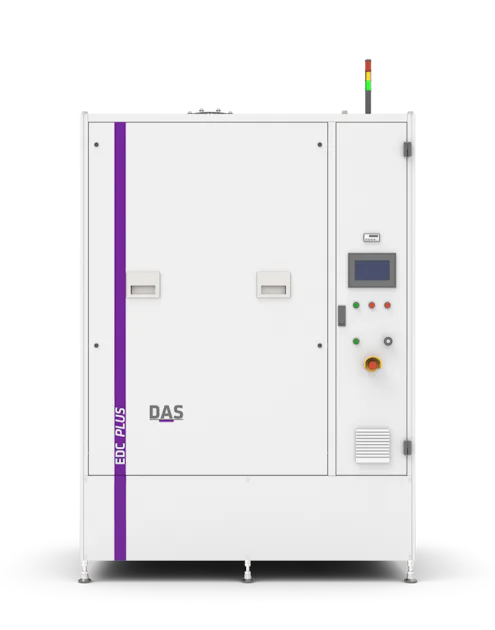
Point-of-Use Waste Gas Treatment with the Electrostatic Filter EDC
With our electrostatic micro and nanoparticle separator EDC (Electrostatic Dust Collector), particle- or aerosol-contaminated process waste gases can be treated directly at the point of use. Such waste gases are produced, for example, in the manufacture of solar cells and also in LED and semiconductor production.
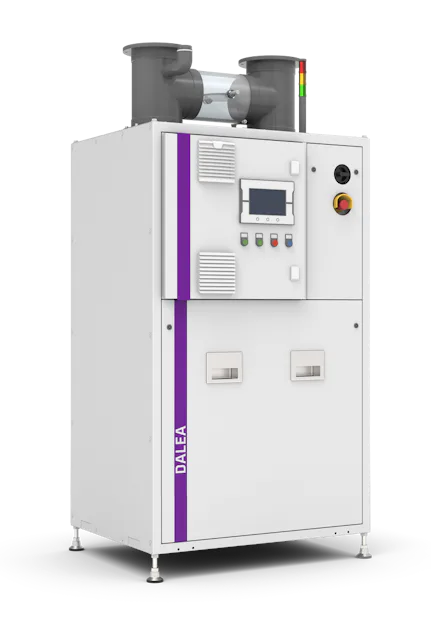
DALEA – Rotary Dust Collectors at Point-of-Use
Rotary Dust Collectors – Our Portfolio
A jet of water is atomised by a high-speed rotating disc. The result is a mist of very fine water drops in which dust particles are centrifuged. The rotor ensures that the waste gases are aspirated and thus moved forward without loss of pressure. The turbulence in the shear gap between the rotor and stator ensures that the water mist and particle-laden process gases are mixed together effectively. The fine dust particles are suspended in the water; the purified waste gas can then be released freely into the environment.
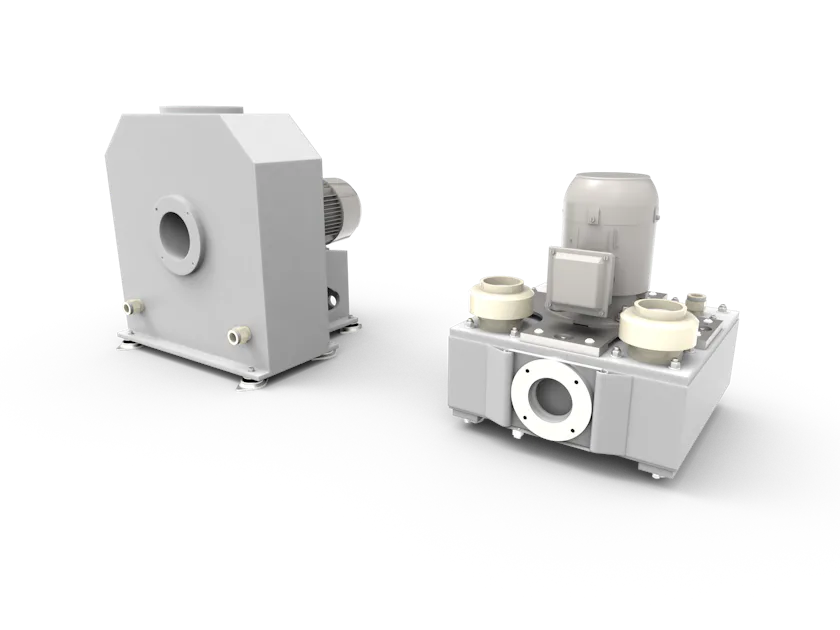
RDC – can be integrated into or added to classic burn-wet systems
The RDC range was developed by DAS Environmental Experts in response to a client’s request. The systems are small, which means they can be integrated into or added to the classic burner-scrubber systems. RDC systems can also be used for much higher dust loads than the EDC systems, as well as for higher waste air flows. In addition, the rotor works as a blower and moves the waste gas forward; this prevents any loss of pressure and even supports the extraction that normally follows. However, RDC systems do not have the same degree of separation efficiency as the EDC range.
