Beyond Industry Benchmarks: >99.9% DRE for CF4
Why >99.9% DRE Matters for Semiconductor Industry - Closing the Gap between Benchmarks and Technological Reality
Executive Summary
The semiconductor industry is under increasing pressure to reduce its direct greenhouse gas emissions. Tetrafluoromethane (CF₄) is particularly critical due to its very high global warming potential and long atmospheric lifetime, meaning even small amounts have a significant climate impact.
Destruction and removal efficiency (DRE) is therefore becoming a strategic factor: while industry standards range from 95% to 99%, achieving >99.9% reduces residual emissions by a factor of ten, making it a key lever for decarbonization and compliance.
The technical challenge lies in the stability of CF₄, which can only be efficiently broken down under precisely controlled thermal conditions. Optimized burn-wet systems are considered an established solution in this context.
High-efficiency abatement reduces emissions and long-term costs, transforming it from a compliance measure into a strategic competitive advantage.
Why Is CF₄ One of the Chip Industry's Biggest Climate Challenges?
The semiconductor industry is under growing pressure to reduce direct greenhouse gas emissions from manufacturing processes. While chip production enables many technologies essential for the energy transition, semiconductor fabs themselves rely on process gases with extremely high global warming potential (GWP). Among them, tetrafluoromethane (CF₄) remains one of the most critical substances.
CF₄ belongs to the group of fluorinated greenhouse gases (F-GHGs) widely used in etching and chamber cleaning applications. Due to its highly stable carbon-fluorine bonds, CF₄ is exceptionally difficult to decompose and has an atmospheric lifetime of thousands of years. According to the Semiconductor Climate Consortium (SCC), CF₄ has a GWP-100 of 7,390[1].
[1] Source: IPCC AR6 WGI (2021), Table 7.SM.7, Greenhouse Gas Emission Metrics.
That means that even very small amounts of CF₄ can have a disproportionately large effect on global warming. For example, emitting just one metric ton of CF₄ is equivalent to releasing 7,390 metric tons of CO₂. This exceptionally high climate impact, combined with CF₄’s long atmospheric lifetime, makes effective gas abatement essential for reducing the semiconductor industry’s greenhouse gas footprint.
At the same time, regulatory frameworks are tightening worldwide. The SCC Whitepaper Overview of F-GHG and Nitrous Oxide Semiconductor Abatement Technologies (2024) highlights the increasing relevance of high-efficiency greenhouse gas abatement and emphasizes that next-generation technologies will be required to support the semiconductor industry’s path toward net-zero manufacturing.
Why destruction and removal efficiency has become a strategic factor
For many years, greenhouse gas reporting in semiconductor manufacturing relied on conservative default assumptions for abatement performance. Today, the industry is moving towards a more precise evaluation of actual destruction and removal efficiency (DRE).
The SCC Whitepaper defines DRE as the measure of how effectively an abatement system destroys or removes pollutants and greenhouse gases. The report further describes that modern point-of-use (POU) systems can achieve high DREs for F-GHGs when specifically designed for these target gases.
Current industry discussions often focus on threshold values above 95% (industry minimum) or up to 99% DRE (maximum goal). However, the difference between 99% and >99.9% efficiency is far more significant than it appears at first glance.
In other words, increasing DRE from 99% to 99.9% reduces residual emissions by another factor of ten. For gases such as CF₄, this difference directly translates into substantial reductions in CO₂ equivalents over the operational lifetime of a fab.
As semiconductor manufacturers increasingly integrate Scope 1 emissions into sustainability strategies and carbon accounting, abatement performance is no longer only an environmental parameter. It becomes an operational and economic factor as well. Scope 1 refers to all direct greenhouse gas emissions released from sources that a company owns or controls—such as process gases, fuel combustion, and on‑site chemical reactions. These emissions fall under the company’s immediate responsibility and therefore have a direct impact on regulatory compliance, reporting accuracy, and decarbonization targets.
“The sustainability performance of an abatement system should be measured by its overall climate impact. For gases such as CF₄, every fraction of a percentage point in DRE matters. By achieving destruction efficiencies above 99.9%, modern burn-wet technologies can significantly reduce residual greenhouse gas emissions and, despite the use of natural gas, contribute positively to a fab’s overall decarbonization strategy.”


The technological challenge of CF₄ abatement
The SCC Whitepaper describes CF₄ as having some of the strongest chemical bonds among commonly used F-GHGs. Efficient decomposition therefore requires precisely controlled thermal conditions and optimized reaction environments. The whitepaper identifies burn-wet systems as one of the most established technologies for semiconductor process gas abatement. These systems use fuel and oxidants to create high-temperature conditions capable of decomposing fluorinated gases.
The document further notes that burn-wet systems generally achieve high DRE when configured specifically for F-GHG treatment. This is precisely where advanced system design becomes decisive.
How TILIA achieves >99.9% DRE
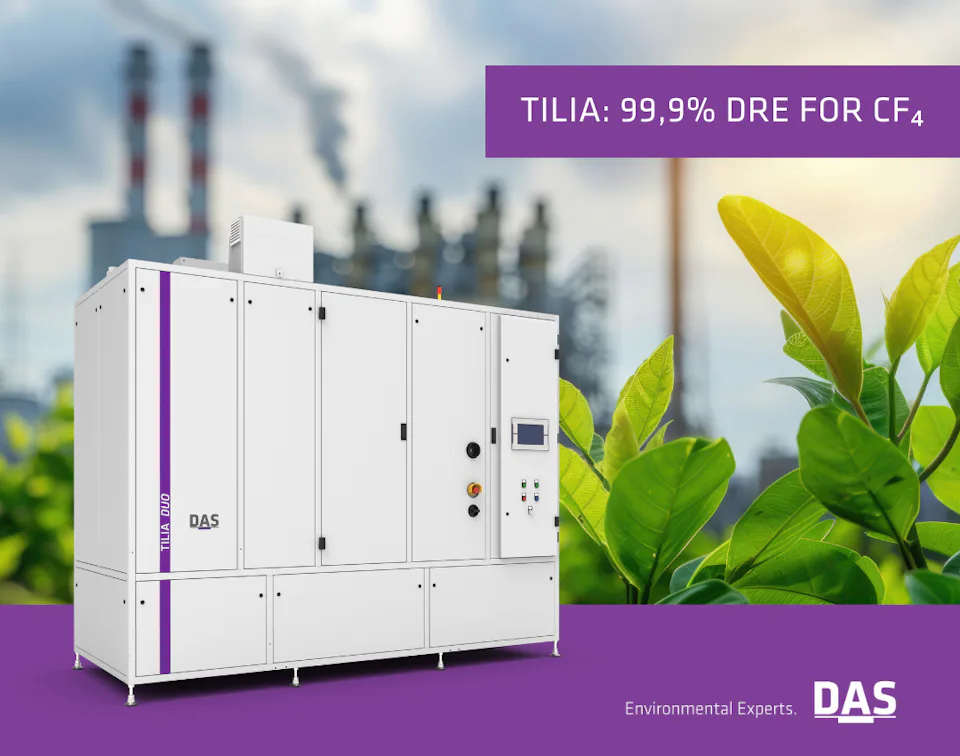
With its TILIA platform, DAS Environmental Experts demonstrates that destruction efficiencies exceeding 99.9% for CF₄ and other fluorinated greenhouse gases are technically achievable within an industrial production environment.
The key differentiator is not a completely new physical principle, but the consistent optimization of proven burn-wet technology for highly stable semiconductor process gases.
Modern burn-wet systems create a controlled thermal reaction zone in which fluorinated compounds are decomposed under optimized combustion conditions before byproducts are removed in downstream wet treatment stages. According to the SCC Whitepaper, this approach remains one of the most versatile and effective solutions for high-flow semiconductor abatement applications.
The performance of such systems depends heavily on process-specific configuration, temperature management, residence time, reagent supply and stable operational control. Small deviations can significantly affect the destruction and removal efficiency, especially for compounds like CF₄.
TILIA addresses these challenges through a highly optimized burn-wet architecture specifically designed for semiconductor greenhouse gas treatment. The result is a consistently high DRE above 99.9% under real fab operating conditions.
This level of efficiency becomes increasingly relevant as fabs move toward validated emissions monitoring and more detailed sustainability reporting. The SCC Whitepaper explicitly emphasizes that actual operating conditions strongly influence DRE performance and that normal production conditions must be replicated during verification measurements.

High-efficiency abatement supports sustainability and cost targets simultaneously
The discussion around semiconductor sustainability often focuses on energy consumption, water reuse or renewable electricity. Direct process emissions, however, remain one of the largest levers for reducing the industry’s climate impact.
At the same time, the economic relevance of abatement efficiency is growing rapidly. Rising carbon pricing mechanisms, stricter emissions regulations and increasing ESG transparency requirements are changing how fabs evaluate infrastructure investments. ESG refers to Environmental, Social and Governance criteria that assess how responsibly and sustainably a company operates, shaping both regulatory expectations and investor decisions.
Higher DRE directly reduces residual greenhouse gas emissions. This lowers the future exposure to carbon-related operational costs while supporting long-term sustainability targets.
The SCC Whitepaper also underlines that advanced abatement technologies are a critical part of achieving industry-wide net-zero goals and that continued innovation in greenhouse gas treatment will be necessary.
From compliance to technology leadership
The semiconductor industry has entered a phase in which “good enough” abatement performance is no longer sufficient. The focus is shifting from minimum compliance toward measurable emissioCns reduction with validated operational performance.Achieving >99.9% DRE for CF₄ demonstrates that advanced greenhouse gas abatement can move beyond theoretical targets and become an industrial reality.
For semiconductor manufacturers, this changes the role of abatement systems fundamentally. Waste gas treatment is no longer only an environmental safeguard in the subfab. It becomes a strategic technology contributing directly to sustainability performance, emissions reduction and long-term competitiveness.
