Fourth Treatment Stage: How To Prepare For New Requirements
Pharmaceutical Industry
How can pharmaceutical trace substances be removed from wastewater? A pilot plant tests ozonation and biofiltration for a future fourth treatment stage.
New Requirements for the Removal of Trace Substances
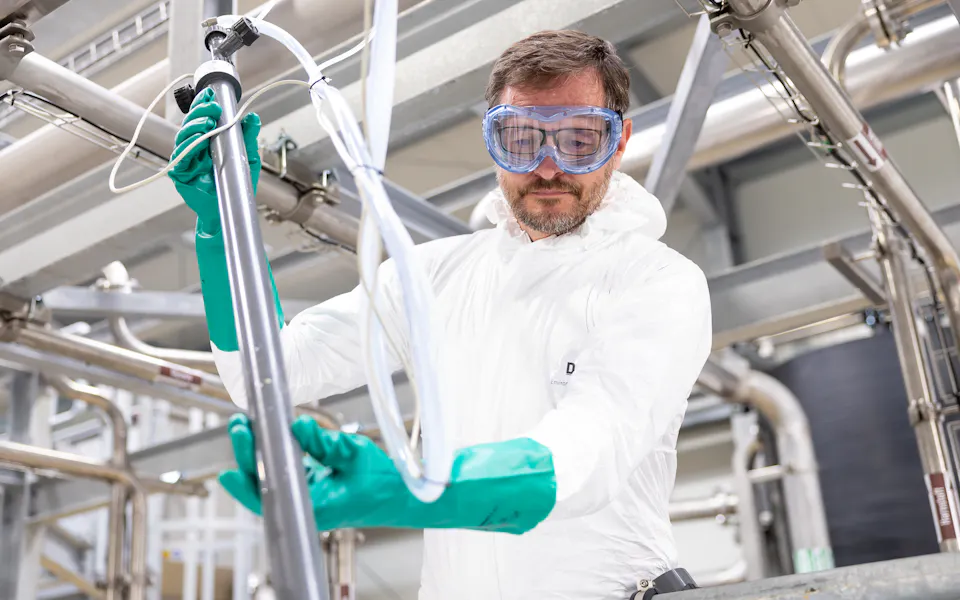
How can pharmaceutical trace substances be effectively removed from industrial wastewater? This is the question facing pharmaceutical companies in the face of increasing requirements for wastewater treatment. DAS Environmental Experts is developing and operating a pilot plant for a German pharmaceutical company that combines ozonation with biologically activated filtration. The aim is to generate reliable real-world data on treatment performance and process behaviour to support the design of a future fourth treatment stage.
Pharmaceutical residues, hormones, biocides and other organic trace substances pose particular challenges for wastewater treatment. Some of these occur in very low concentrations and are not completely removed by conventional biological treatment processes.
At the same time, regulatory requirements are increasing. With the amended EU Urban Wastewater Treatment Directive, greater emphasis is being placed on the more thorough removal of micropollutants. This development is particularly relevant for the pharmaceutical industry: in addition to potential discharge limits, the regulation provides for extended producer responsibility for pharmaceutical and cosmetics companies.
For industrial companies, the question of suitable technology therefore arises not only when specific requirements come into force. New treatment concepts must be assessed and tested at an early stage and tailored to the specific composition of the wastewater.
DAS Environmental Experts has been commissioned by a German pharmaceutical company to plan and implement a pilot plant. The aim of this pilot project is to investigate how active pharmaceutical ingredients (APIs), which are difficult to degrade using conventional methods, can be removed from wastewater. The focus is on a combination of ozonation and downstream biologically activated filtration.
The key objective of the pilot study goes beyond demonstrating the basic effectiveness of the process: the aim is to obtain reliable data on cleaning performance, operational behaviour and system integration under conditions that closely resemble real-world scenarios. This data will then form the basis for the process engineering and economic design of a potential large-scale fourth treatment stage.
From regulatory challenges to tangible plant design
Smart combination of ozonation and biofiltration
In the first step of the process, ozone is introduced into the wastewater via a Venturi injector. The intense mixing ensures that the oxidizing agent is distributed homogeneously throughout the water. A defined reaction time then follows.
Ozonation oxidatively degrades or breaks down hard-to-degrade trace organic compounds. However, this process can result in the formation of transformation products. Therefore, the treatment does not end with ozonation.
A downstream biologically activated filtration system handles the subsequent treatment. Thus, the plant design combines three principles of action: oxidation, adsorption, and biological degradation.
A direct comparison of three filter media
The most suitable filtration method for a specific wastewater stream cannot be determined based solely on theoretical design values. For this reason, the pilot plant allows for the parallel operation of three different filter media:
Sand serves primarily as a support medium for biological degradation processes.
Activated carbon combines biological processes with additional adsorption.
Expanded clay is being investigated as an alternative carrier material with specific surface area and colonization properties.
The filters can be operated both with and without upstream ozone dosing. This allows to determine the extent to which ozonation contributes to overall removal and how it influences the subsequent biological treatment.
Rather than specifying a technology in advance, the pilot study thus provides a reliable basis for decision-making regarding the future plant design.
DAS Technology for Pharmaceuticals, Biotechnology, and Health Care
All the way from planning, through switching station construction to quality assurance, the environmental experts from Dresden successfully met the high requirements of the pharmaceutical industry.

Measure, compare, optimize
During the trial phase, DAS Environmental Experts operates the pilot plant and evaluates the relevant operational and analytical data. The organic load is measured, among other things, using the spectral adsorption coefficient (SAK254). Supplementary sampling and bioarrays provide further insights into water quality and ecotoxicity before and after biofiltration. This allows for an assessment of how effective the individual process stages and filter media are under real operating conditions.
Pilot projects as the basis for investment decisions
Lab tests can demonstrate whether a process works in principle. However, other questions are crucial for planning an industrial plant: How stable is the process under real-world conditions? What dosage is required? Which filter medium is suitable? How do the process stages interact? And how can the concept be integrated into the existing infrastructure later on?
This is precisely where technical-scale pilot testing comes into play. The operational and analytical data obtained make it possible to evaluate different variants based on their removal efficiency, operational behavior, and long-term applicability. In this way, pilot testing reduces uncertainties in the subsequent design phase and provides a sound basis for technical and economic investment decisions.
From the initial idea to the operation of the pilot plant
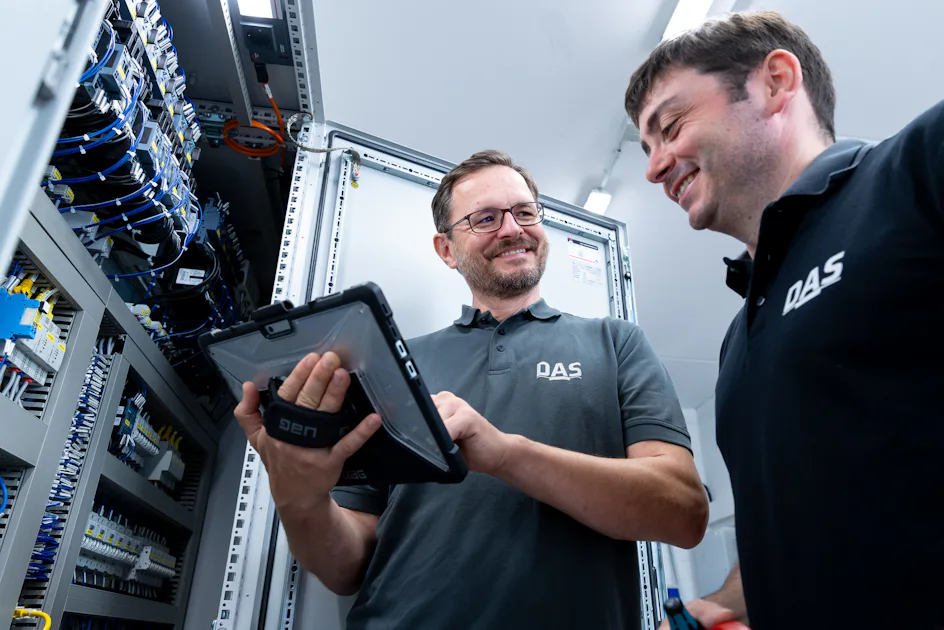
DAS Environmental Experts supports the project throughout the entire process. The scope of services includes process design, mechanical and electrical planning, and software programming. This is supplemented by the delivery and installation of components, project management, construction management and supervision, as well as commissioning.
During the trial phase, DAS will operate the pilot plant, conduct tests and take samples, provide remote maintenance support, and evaluate the results obtained.
In this way, the project combines process engineering development with practical operational experience—with the goal of developing a robust solution for continuous industrial operation based on a promising treatment concept.
Testing today what is supposed to work on a large scale tomorrow
The removal of micropollutants will increasingly shape industrial wastewater treatment in the coming years. However, which solution makes technical and economic sense for a specific site depends heavily on the composition of the wastewater and the operational conditions.
Pilot plants make it possible to answer these questions before a decision is made on a full-scale investment. The project demonstrates how ozonation and biologically activated filtration can be investigated and optimized under real-world conditions—and how regulatory requirements can lead to a custom-designed treatment concept for the fourth treatment stage.
Your Contact Person for all Questions on Wastewater Treatment
For customized and safe wastewater treatment plants.